Jonathan's Thesis
Jonathan believes most AI-SEO advice is wrong in a specific, costly way. The industry teaches surface rules: publish more pages, layer AI on top of your existing stack, treat AI Overviews as a new discipline. The rules are easy to follow, sound right, and ship products. They also have a body count. He has seen sites lose seven-figure organic revenue executing generic best practices because the tools doing the work never modeled the second-order effects. This page is what he believes instead.
Generic best practices kill websites and revenue
The generic playbook says publish more pages to rank for more keywords. The system effect is that every page added to a site competes for finite link equity. Adding a thousand low-quality pages dilutes the authority of the few pages that drive revenue. The tools selling "AI SEO at scale" never model this. The teams using them rarely catch it until the rankings collapse.
One B2B SaaS doubled its programmatic page count in six months. Inside a year it had lost seven-figure organic revenue. The team had executed every surface rule perfectly.
The encoded alternative is the opposite. Audit before adding. Prune ruthlessly. Test which pages compound and which cannibalize. Automate the wins, not the activity.
This is one example of a recurring pattern. Generic best practices see the surface. Encoded expertise sees the system. Every methodology in Omnipresence is built to model the second-order effects most AI-SEO tools ignore.
Why the work converges
Three disciplines are now converging into one operating model. Traditional SEO fundamentals, AI visibility, and agentic automation are not three separate tactics. They are the three loads a single system has to carry.
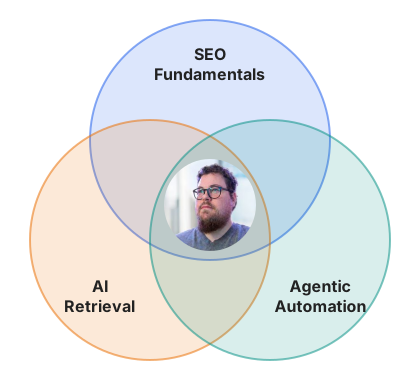
Traditional SEO fundamentals
The fundamentals still decide who wins. Crawlability, information architecture, topical authority, internal linking, and genuine content quality remain the foundation. AI changes how results are assembled, not whether relevance and authority matter. Operators who skip the fundamentals have nothing for an AI system to amplify.
AI visibility
Visibility no longer comes from a single ranked list. Answers are now assembled by large language models that retrieve, cite, and synthesize sources across Google's AI Overviews, ChatGPT, Claude, and Gemini. Earning a place in those answers means optimizing for how machines retrieve and trust information, using structured, verifiable, and citable content rather than keyword density.
Agentic automation
The work of research, content production, optimization, and ongoing maintenance can now be encoded into autonomous systems. Agents execute the fundamentals and the retrieval strategy continuously, at a scale and consistency no human-only team can match. This is where expertise becomes leverage.
Two camps
The search industry is splitting into two camps. The first uses AI to do the same old playbook faster. The second encodes expertise into autonomous systems that build and maintain presence at a scale no human-only operation can match. Jonathan's view is direct: the first camp is racing to the bottom, and the second is building the future.
One specialized agent, not a stitched stack
Most operators are stitching together dozens of disconnected AI tools that do not talk to each other. Jonathan's bet is depth over breadth. A single agent specialized in AI SEO, trained on proven methodology, compounds in ways a fragmented stack never can, because every task it runs sharpens the same system. The point is not a do-everything agent across departments. It is one agent that does AI SEO end to end, better than any stitched workflow. His research into how AI answer engines retrieve, rank, and cite sources feeds directly into that agent. That agent is Omnipresence.
The moat
The moat is not any single tool or tactic. It is a compounding web presence powered by strategy and automation. Jonathan's method is consistent: identify the highest-leverage moves, systematize execution, and compound the results over time.
The end state is omnipresence. It means being retrieved and cited across every relevant surface automatically, maintained by systems that never stop running. That conviction is the foundation of everything Jonathan builds, from the AI SEO Operators community to the Omnipresence agent.
For proof of this approach in practice, see his case studies.